 Epiphany - an illuminating discovery, realization, or disclosure
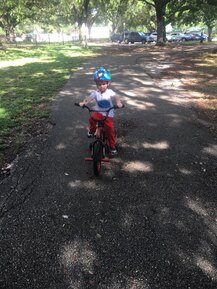
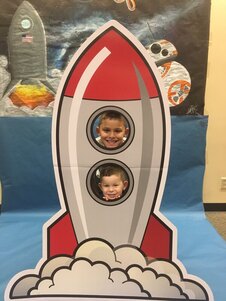
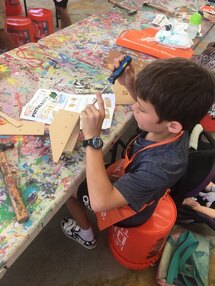
https://www.merriam-webster.com/dictionary/epiphany I am an early riser. If you or your children have ever noticed the time I submit feedback on assignments, you will often notice that it was submitted at 5:30 a.m. or 6:00 a.m. Not only am I an early riser, but my mind is on overdrive the moment I am conscious. This morning’s topic on my mind was an epiphany...that feeling that you truly “get” something. Charlotte Mason has long been my educational mentor and I have studied her ideas at great length. I have also adapted her approach in homeschooling my own children. Basically, she advocates a literary education. But what does this mean, exactly? I know she condemns “twaddle” her word for inferior literature and I condemn it as well. Why waste precious time on reading that is useless when there is so much loftier and uplifting material at hand? So this morning, my 5:00 a.m. epiphany centered on science. I still own some excellent science textbooks, however, that is just the point. They are textbooks, and no matter how good they are, they are not particularly inspiring. A literary science book, on the other hand is!!! I know this in the depths of my soul, but could never quite articulate it. When was the last time you heard someone say they were inspired by their textbook reading? This applies to other subjects as well of course. It is why my literature courses use classics, not literature textbooks. We read the whole book, not just a snippet or chapter and explore it in depth. Some examples of literary science books I have read and been inspired by are below. I have learned so much from them and far more than I would have learned by reading a textbook. But the most important thing is that I care! Charlotte Mason says... “The question is not, -- how much does the youth know? when he has finished his education-- but how much does he care? and about how many orders of things does he care? In fact, how large is the room in which he finds his feet set?and, therefore, how full is the life he has before him?" Charlotte Mason - 19th century educator [This post contains affiliate links for products I love. If you make a purchase through one of these links, I will earn a commission at no extra cost to you.] I read Moths of the Limberlost by Gene Stratton Porter out of curiosity, not because I was particularly interested in moths. How did I come to read this book? Through literature! First, I read Porter’s book, Laddie, which I liked so much that I then read, Girl of the Limberlost. A biology textbook would tell me that moths are insects in the animal kingdom. Big deal. Who cares? But after reading Porter’s book on moths, I have gained knowledge and a real appreciation for these insects. Starlight in Time by Dr. Humphreys explains how light-years figure into a young Earth creation timeline. He also discusses black holes, white holes, and the expanding universe. These are just a small sample of literary science books. I have learned so much from them and far more than I would have learned by reading a textbook. You can learn most anything through the avenue of literature. Literature isn’t just novels. 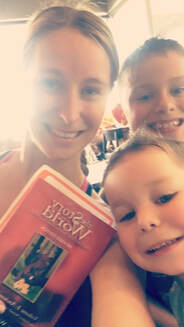 by Angela Jacobs "What do you do all day?" I have heard this question many times over the years. People who have never met a home-schooled child are always so curious and may have never heard of homeschooling before. Some have the mistaken impression that we sit behind a desk all day while our mother lectures us on all subjects as we fill out the corresponding worksheets. Others think that homeschooling means we attend an online classroom and our parents are rarely involved in the actual educating. Then there are some who think we do nothing more than goof around singing songs and painting pictures all day. While each of those types of homeschooling families definitely exist, they aren't what I have come to view as typical. What home-schoolers almost always have in common is not only the desire to provide their children with a better education, but to establish deeper connections with them as well. What better way to do that than to feed their hungry young minds? Home-schoolers realize that it's not how children learn that matters, but that they learn, and that their love of learning is not squelched. We combine whatever techniques work for our own children and, if we need to, make it up as we go. So what does homeschooling actually look like? It's riding your bike in the park for PE, and making a Home Depot kids' project for workshop. It's teaching your kids fractions as they measure the ingredients you need for dinner. It's using textbooks as a guideline, while taking every real-life situation as an opportunity to teach them new skills and reinforce old ones. Homeschooling looks different for every family because every family is different. 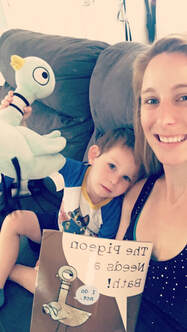 It looks like letter crafts at the kitchen table or literature on the couch with your favorite stuffed pigeon. It's seeing the planetarium exhibit when it comes to the local library and reading the history book out loud to your kids in a Starbucks.
 This article expresses the observations of one university professor regarding homeschooled students, but there are many similar observations from others.
"The following 16 weeks, she maintained eye contact throughout lectures and discussions, listened intently to me and her classmates, raised her hand to offer an observation, an answer or to ask a question when no one else would, followed instructions to the letter, communicated verbally and in writing more clearly than everyone else and received the highest grade on every assignment." 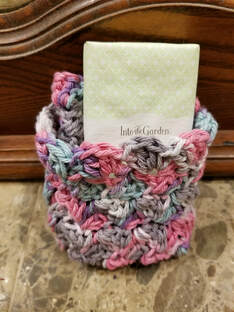 Over Spring Break I had the pleasure of visiting my daughter and her family. While there, she taught me how to crochet this little washcloth made with cotton thread, complete with a scalloped border! It's a simple project, especially for her. As a homeschool mom, we did handicrafts from time to time and I taught my daughter the basics of crochet. Now, she knows far more than I do! That is why she teaches me. She has won 1st place ribbons at the state fair for her crocheted dolls and has made this adorable Tinkerbell outfit for her baby girl as well as a stunning Irish lace table runner for me. 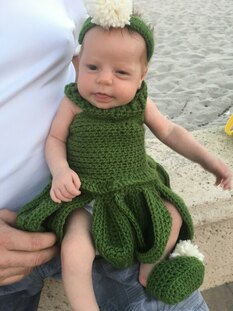 What does all of this have to do with
homeschooling? EVERYTHING! Many times I have heard moms lament that they cannot teach their children something because they don't know how or don't know enough. That is a serious barrier sometimes. But what they don't realize is that if they know enough (or can learn enough) to get their children started, the children can learn more themselves. Isn't that the goal...to foster independent learners? |
Renee MetcalfWhere will you find me when I am not teaching? For your reading pleasure!
August 2023
Topics
All
|
 RSS Feed
Photo from jofo2005
